the things we keep meaning to do
do you remember the last time you had a cold?
not a terrible one. nothing worth flowers on the kitchen counter or voices lowering when they ask how you are, just enough to make breathing something you had to think about, which is strange when you consider how many years you had been doing it without once thanking the machinery of your own lungs.
you lay there with your mouth open, bargaining with something you did not believe in.
just let me feel normal again.
normal—the thing you had been trying to escape only days before.
it is the peculiar cruelty of only noticing a thing when it becomes difficult: breathing, walking, swallowing, sleeping, loving someone who is still alive. there are entire miracles happening inside of you that you will not notice today. your heart will beat approximately one hundred thousand times and you will complain about an email.
this is not an accusation. i complained about the dishes this morning. there were too many of them, which meant i had eaten. the laundry had become a small country on the bedroom floor, shirts folded into mountains, socks disappearing across borders, and i stood above it all exhausted by the evidence that i had been clothed every day of my life. the refrigerator was full of food i did not feel like cooking. the phone was full of people i had not called. the bookshelf was full of books i bought because i wanted to become the sort of person who had time to read them.
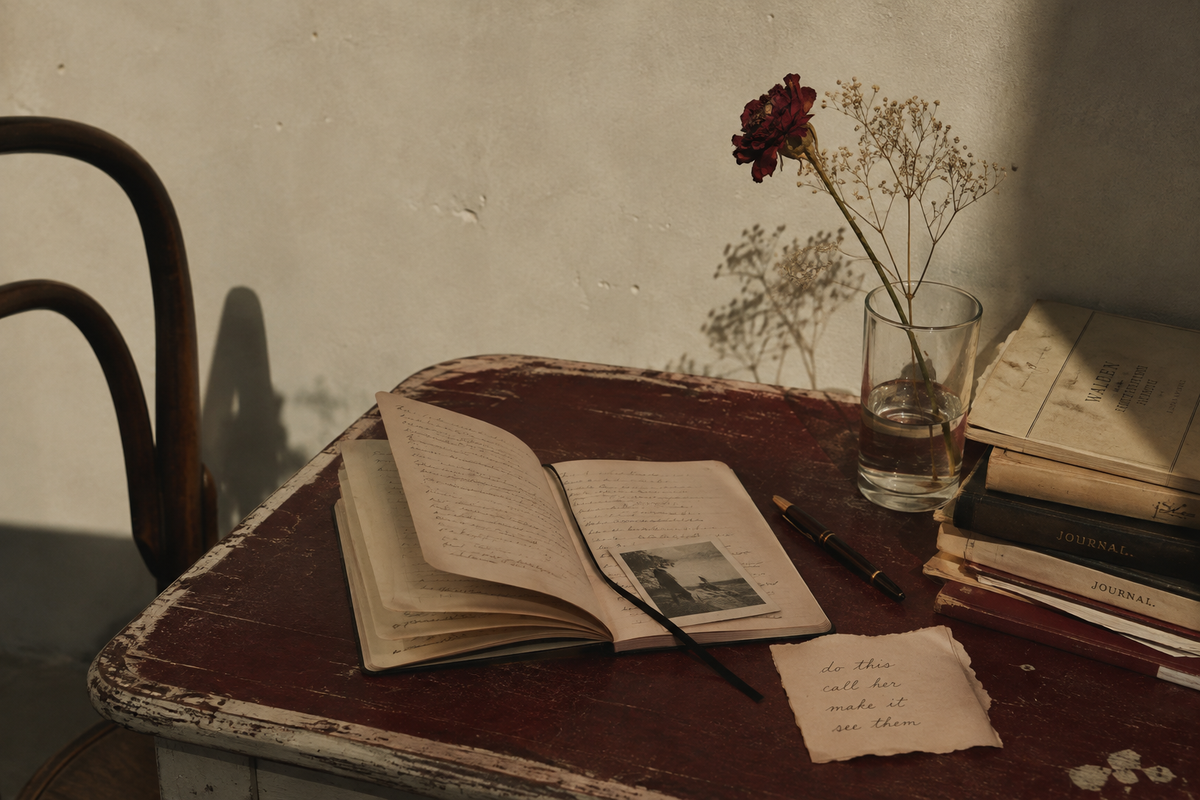
and somewhere, in a drawer i keep meaning to organize, there is a pen. it is a good pen—too good, which is how we ruin most beautiful things by saving them. the expensive candle stays unlit. the dress waits for an occasion important enough to deserve it. the good plates survive generations without ever learning the weight of a sunday dinner. the pen waits for something worth writing.
there is also a box.
i don't open it often. it sits on the top shelf of the closet, behind things i use more frequently, which is perhaps the point. inside are objects that once felt urgent and now feel fragile: ticket stubs from a concert i barely remember, a birthday card written in handwriting that has since disappeared from my life, a photograph of people standing closer together than they do now. none of it is particularly valuable. none of it would survive a move if i were being practical.
and yet i keep it.
we all have some version of this box. a place where we store proof that we have lived, even if we do not always feel like we are living now. it is strange how easily we archive our past while postponing our present, how carefully we preserve what has already happened while hesitating to fully enter what is happening.
the pen belongs in that box, though it has not yet earned its place.
i want to be an author. i have wanted this for so long that the wanting itself has begun to feel like an accomplishment.
one day, i say. when things slow down.
but things do not slow down. they are not horses; they do not become tired from carrying us. morning arrives with it’s mouth open and we feed it everything—the hours when our minds are clearest, the years when our bodies are kindest to us, the small and unnamed pieces of ourselves we are certain will grow back. we give away our good knees and our unlined faces, the part of our brain that once invented entire worlds while staring out of a car window, and we do it so gradually that nothing ever feels stolen. that is the cleverness of it. a life rarely disappears all at once. it leaves in increments small enough to fit inside a calendar.
there is always a reason, and that is the dangerous part. the reasons are good. they love us, even. they sound like responsibility and necessity and just getting through this week. so we keep going, because stopping feels like something only people with more time are allowed to do, and somewhere along the way exhaustion becomes evidence that we are trying hard enough. we begin carrying our tiredness like proof of purchase. look, we say without saying it. i have paid for my place here.
the body follows because it has always followed. it wakes when we tell it to, swallows what keeps it moving, closes its eyes when there is finally nothing left to ask of it. we learn to silence every small rebellion—the heaviness behind the eyes, the ache in the shoulders, the strange grief of sunday evening—and become so good at continuing that we mistake continuation for being alive.
somewhere in all of this, we became extremely efficient at being alive. i am not sure we became any better at living. a life can be full and still never be entered; you can spend forty years standing in the doorway of your own existence, keys in your hand, saying in a minute, after this, when things calm down. the door does not care. the room gets dark anyway.
do you remember being seventeen and wanting desperately to be older? you should forgive yourself for that. seventeen-year-olds are not known for their understanding of time, and neither are thirty-year-olds or seventy-year-olds. we keep thinking age will teach us how to live, as though wisdom arrives automatically with the wrinkles, as though an old person is not simply a young person who kept waking up.
that is why photographs hurt—not because the people in them are gone – sometimes they are sitting beside us, but because the moment is. there it is: the afternoon we thought was ordinary, the body we spent years punishing only to one day wish we could return to it, the apartment whose walls felt too small until someone else began living between them, the mother whose name lit up our phone while we were too busy becoming adults to answer, the friend we loved with the careless certainty of people who had not yet learned that forever can end, the dog sleeping in the corner of the photograph, unnoticed then and now the first place our eyes go. there it is—the life we did not know we would miss.
we are always becoming nostalgic for things we are currently complaining about.
i keep thinking about the pen. it was bought years ago, on an afternoon that no longer exists. there was a bookstore, or perhaps a stationery shop; memory is unreliable, though photographs lie too by pretending the moment had edges. i remember holding the pen and thinking that a serious writer should own something heavy, something with weight, as though the sentences might be embarrassed to arrive through plastic. i brought it home and placed it carefully in the drawer—for later.
later is where we put everything we are afraid to lose, and where we lose most things.
the pen stayed there through birthdays and winters, through the year everyone said went by quickly and the year after that, which went by quicker. it survived job changes and furniture rearrangements and the slow disappearance of people from photographs. occasionally the drawer would open; a hand would move over it searching for batteries, receipts, a key that belonged to something no one could remember. the pen would be seen. not today. the drawer would close. this happened often enough to become a life.
there are people who want to be authors who barely have time to pick up a pen, painters whose brushes have hardened in cups, musicians who have not touched the piano since they started working enough hours to afford one. there are passports in bedside tables and swimsuits that have never seen the ocean, recipes saved for dinners no one has invited anyone to. fathers keep saying they will take fewer shifts next year. mothers cannot remember the last photograph they were in because they were always the one taking it. friends who love each other deeply communicate almost exclusively by saying, we need to get together soon.
we have built an entire language around postponement and somehow made it sound hopeful: one day, next year, when i have more money, when i lose the weight, when work settles down, when i am less tired, when i become someone else. we speak about our future selves as though they are not us, as though some more disciplined, more beautiful, less frightened person is waiting several years ahead, ready to inherit all the things we were too afraid to begin—the books, the countries, the apologies, the good wine, the difficult conversations, the pen.
it is a lot to ask of someone who does not exist.
and still, tomorrow morning, the alarm will ring. we will wake up and begin negotiating with the day, asking this hour to become evening, this week to become summer, this life to hurry toward the part where we finally have time to live it. we keep asking life to hurry, and life, an obedient thing, does.
then we grieve it for listening.
one day the face in the mirror belongs to someone older than the person in our head. a song from our childhood plays in a grocery store. the people who raised us begin asking us to read the small print. we drive past a house we used to live in and someone else has painted the door, someone else is standing in the kitchen, someone else is complaining about the dishes. you want to knock and say, look at it—you are inside something you will miss—but they would think you were insane.
we know when we were happy far more often than when we are. happiness in the present tense rarely introduces itself; it looks like nothing—toast in the morning, someone calling from another room, a hand reaching across the car without thinking, a body that does not hurt, a tuesday. because it looks like nothing, we treat it like nothing until it becomes something: a photograph, a voicemail, a recipe in someone else’s handwriting, a shirt that no longer smells like them. then we understand it was everything.
how many of the things irritating us today are already becoming sacred without our permission—the fingerprints we keep wiping from the glass, the shoes we keep tripping over by the door, the phone ringing at the wrong time, the voice asking when we will be home as though home has always been a place where someone is waiting? how many times have we wished for silence without asking what had to disappear to create it?
there is another quiet habit we have, one that feels almost harmless: we measure our lives against versions of other lives we only partially understand. we scroll past curated moments and compare them to our unedited afternoons. we assume everyone else has already begun the life we are still preparing for. we forget that they, too, have drawers, and boxes, and pens waiting for later.
comparison is another form of postponement. it convinces us that we are behind, and being behind feels like a reason not to start.
one day, if we are lucky, there will be a final ordinary morning. nobody will tell us. there will be no music, no narrator. the light will come through the same window it has come through a thousand times before, touching the same dust we keep meaning to clean. there may be dishes in the sink and a shirt on the floor and something in the refrigerator we forgot to throw away. we will not know to be grateful.
there will be a last time someone calls our name from another room, a last time we lock the front door, a last time we complain about the weather, a last cup of coffee we will drink without understanding that the cup has become a ceremony. we are always crossing finish lines backwards; only after we have passed them do we turn around and understand what they were—childhood, a friendship, a home, a version of ourselves.
the last time your father picked you up, neither of you knew to count it. the last time you played outside until the streetlights came on did not announce itself as the end of anything; you simply went inside for dinner. that is how most things leave us—not with a slammed door, but with dinner, with tuesday, with see you tomorrow, and then, eventually, without.
there must be some mercy in not knowing when the last time is. still, I wish we were better at noticing—not everything, that would be unbearable, but something. enough to stand in the kitchen, surrounded by the mess of a life being lived, and resist the urge to call it a mess. enough to cook the food and understand, briefly, that hunger is not the tragedy. enough to look at the laundry and think someone wore these clothes, someone was here. enough to answer the phone, to light the candle, to use the good plates on a wednesday, to stop saving our lives for people we have not yet become.
i keep thinking about the pen. by now you probably think i am going to tell you that i finally opened the drawer, that i picked it up, that i wrote something beautiful. stories like neat endings. people do too. we like to believe realization is the same thing as change.
it is not.
the drawer is still closed. the dishes have not washed themselves. morning is already somewhere on its way, carrying another day i will be expected to know what to do with. understanding something does not make it easier to live by. the world does not rearrange itself simply because, for one unbearable second, you finally saw your life while you were still inside it.
tomorrow i may forget all of this. morning may arrive too loudly, and i may surrender myself to it before i remember what i promised tonight. i may hurry past something beautiful without knowing it was beautiful, let a familiar voice go unanswered because i am certain there will be another time, and once again place the life asking to be lived somewhere safely out of reach—next week, perhaps, or soon.
i may become, again, the person this story is trying to warn me about.
but tonight—
the drawer is open.
the pen is in my hand. it is heavier than i remember, or perhaps my hands have changed. there is a blank page in front of me. for a long time, i do nothing.
then I write:
do you remember the last time you had a cold?
and somewhere, without ceremony, the ordinary life i kept waiting to live begins.